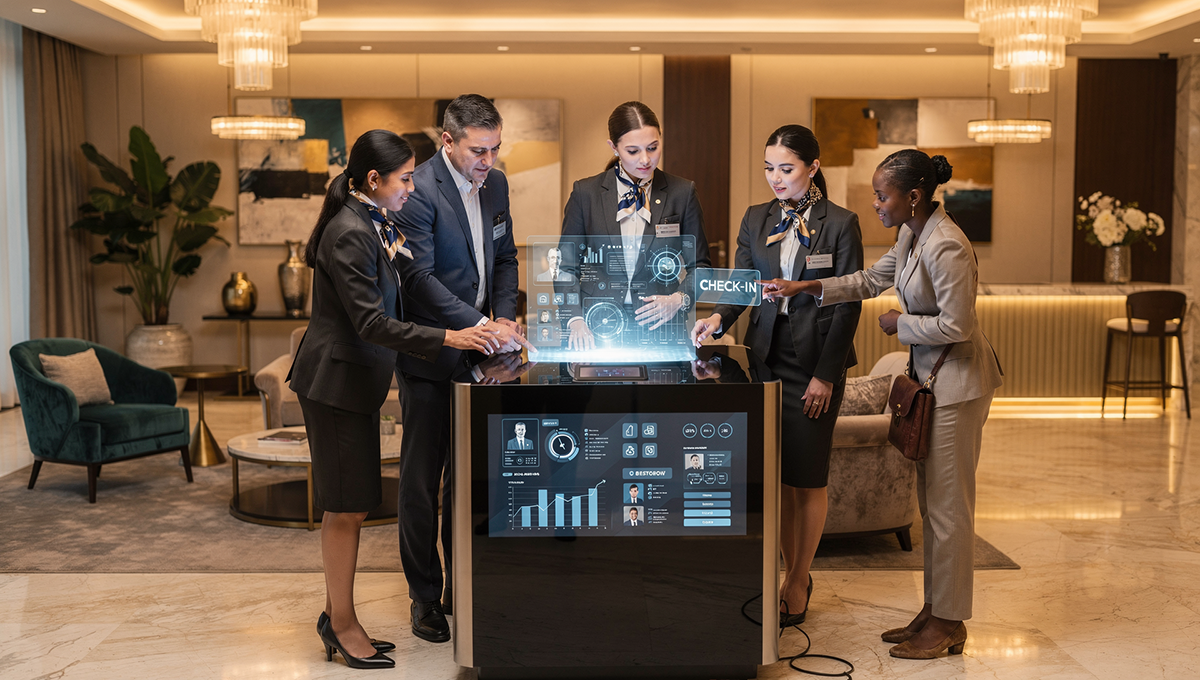
The hotel industry is going through its biggest technological transformation in decades. 89% of hoteliers plan to implement new AI applications in 2026, according to the IDeaS Future Forecast report, while the AI-in-hospitality market is projected to grow from about $90 million to more than $8 billion by 2033. This isn’t just another year of gradual innovation: industry experts call it a “tipping point” that will separate the hotels that are prepared from those left behind.
📊 Key takeaways:
- Mass adoption: 89% of hoteliers will implement new AI solutions in 2026, with the market projected to grow from $90M to $8,000M by 2033
- Measurable impact: Hotels using AI report up to 19% higher RevPAR, 30-40% lower operating costs and 17% more revenue than competitors without AI
- A critical year: 2026 marks the turning point from generative to agentic AI; hotels that don’t act now will lose a competitive edge they can’t get back
Chatbots that talk like humans and never sleep

Virtual assistants have evolved from simple FAQ responders into true digital concierges that can manage reservations, recommend local restaurants and solve problems in real time. 70% of guests find chatbots useful for simple inquiries, according to the State of Hotel Guest Tech Report 2025, although they still prefer human interaction for complex requests.
Marriott leads the way with RENAI, the virtual concierge launched for its Renaissance Hotels brand, which combines ChatGPT data with local recommendations and is available via WhatsApp. Hilton deploys Connie, powered by IBM Watson, while its Xiao Xi chatbot for the Chinese market has answered more than 50,000 inquiries with 94% satisfaction. Hyatt reports that its contact center virtual assistant handles 7 million calls a year, generating $4.4 million in savings.
“Chatbots built on advanced language models are reaching 90% satisfaction rates, making them one of the most effective support tools in the industry” — Hotel Tech Report, 2025
Predictive personalization that anticipates what guests want
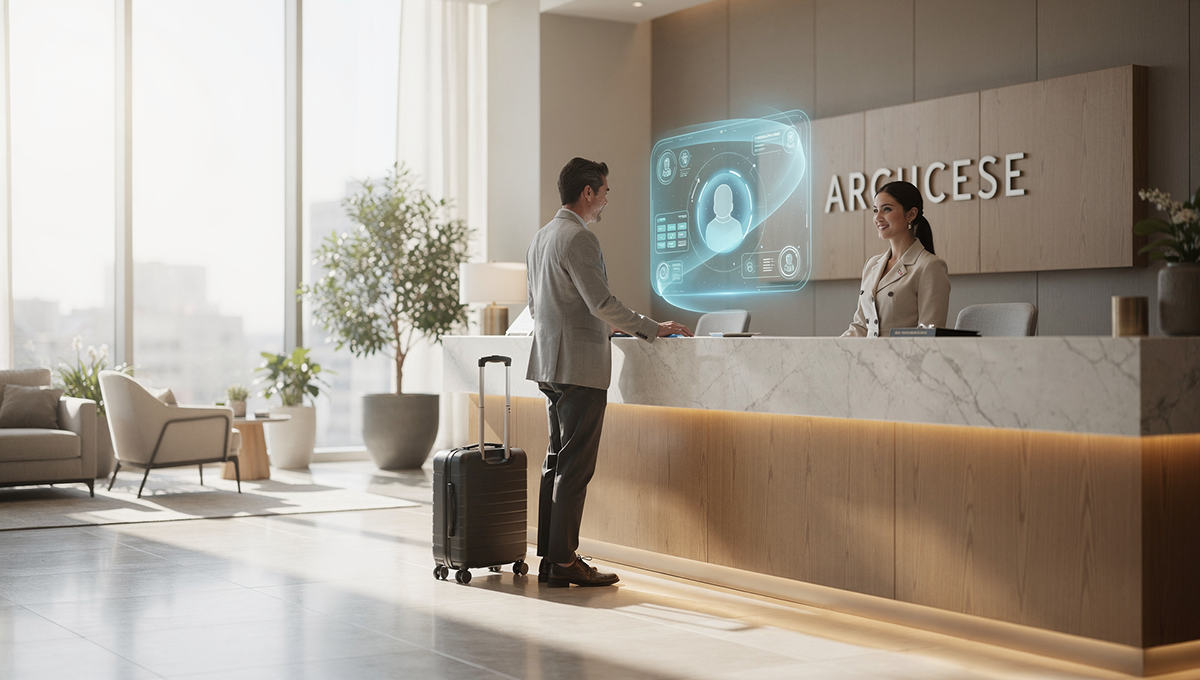
AI no longer just remembers that you prefer firm pillows: it predicts what you’ll want before you ask. The sequence hotels in Japan use NEC I:Delight technology for 30-second check-ins with nothing more than a smile, while IHG launched a generative travel planner in 2024, built into its IHG One Rewards app and developed with Google Cloud and Gemini models.
Personalization works at three critical moments. Before arrival: emails with recommendations based on booking history and personalized upgrade suggestions. During the stay: rooms that automatically adjust temperature, lighting and music to learned preferences. The Ritz-Carlton uses chatbots that remember guests’ dining habits from previous visits. After the stay: future offers based on sentiment analysis of guest feedback.
“The era of the one-size-fits-all experience in hospitality is truly outdated” — Otonomus Hotel representative
The impact is measurable: 73% of guests are more likely to book when a hotel uses AI to personalize recommendations, and hotels report 10-15% increases in satisfaction after implementing these technologies.
Robots and automation are transforming operations
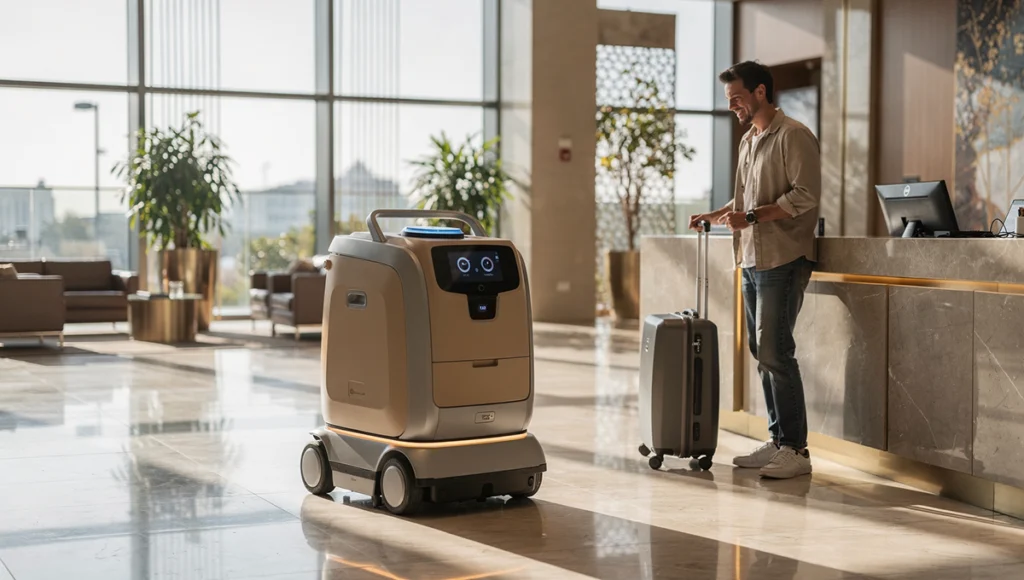
Robots are already roaming hotel hallways delivering towels and snacks. Whiz, developed by SoftBank Robotics, learns up to 600 cleaning routes and can cover 1,500 square meters on a single charge, and is in use at Millennium Hotels. Aloft Hotels’ (Marriott) Botlr robots deliver toiletries straight to guest rooms, while SOMATIC disinfects bathrooms autonomously at roughly a third of the cost of an employee.
AI-driven predictive maintenance offers one of the clearest returns on investment. IoT sensors monitor HVAC systems, elevators and kitchen equipment in real time, predicting failures before they happen. The results: maintenance costs down by up to 30%, downtime reduced by up to 50%, and equipment lifespan extended by 25% to 50%.
Hotels that implement end-to-end automation report a 30-40% reduction in operating costs. A McKinsey study found that AI adopters report 17% more revenue and 10% higher occupancy than non-adopters.
AI revenue management maximizes every booking
AI-powered revenue management platforms analyze hundreds of variables in real time, including competitor rates, local events, weather forecasts and historical patterns, to update prices thousands of times a day. Duetto, ranked number one at the 2025 HotelTechAwards, offers independent “open pricing” by segment, room type and channel. IDeaS G3 RMS uses machine learning for automated forecasting, while Atomize specializes in small and mid-sized properties.
The results are compelling. A Cornell University study documented average revenue increases of 7.2% at hotels with AI systems. Lighthouse clients report RevPAR increases of more than 19%. A 50-room boutique hotel in Jaipur achieved a 20% year-over-year increase in RevPAR during a local literature festival, dynamically raising rates by up to 25% based on demand spikes detected by AI.
“AI is transforming how we forecast, price and strategize. Hotels that embrace AI-driven insights won’t just stay competitive, they’ll lead the charge in adapting to a rapidly evolving hotel landscape” — Jordan Hollander, co-founder of Hotel Tech Report
Checking in with your face instead of documents
Facial recognition in hotels has gone from science fiction to operational reality, especially in Asia. Mitsui Fudosan’s sequence hotels in Japan allow check-in in 30 seconds with just a smile, with no physical keys or cards; all access is biometric. In China, Marriott has deployed kiosks with Alibaba/Alipay that verify identity and process payment automatically.
The global market for biometrics in hospitality is projected to reach $13.2 billion by 2026. The technology has advantages over the alternatives: according to Terry Schulenburg of CyberLink, “facial recognition doesn’t require touching anything, and spoofing the system, even with a photo or mask, is almost impossible,” unlike fingerprints, which are vulnerable to environmental conditions and spoofing.
Hilton leads in digital keys, with 14.3 million Digital Keys downloaded between January and August 2024, saving approximately 100 tons of plastic a year. Mobile key adoption was projected to exceed 70% globally by 2025.
Generative AI is rewriting hotel marketing

Generative AI has found immediate applications in marketing and communication. DuveAI automates interactions using ChatGPT-4 capabilities, Canary AI handles up to 80% of inquiries and translates into more than 100 languages, and tools like MARA generate personalized replies to reviews while keeping the brand’s voice.
Marriott uses natural-language search on Homes & Villas, where users describe their ideal vacation (“an A-frame cabin in the mountains with a fireplace and a great view”), with notable results: users who interact with the AI search are twice as likely to save properties as favorites. The chain has identified more than 200 AI use cases through its AI Incubator.
“2025 is expected to see a pivotal shift, where the first successful commercial deal between an AI engine and a major travel player could act like ‘a dam breaking'” — Steve Hafner, CEO of Kayak
2026 is the year that separates winners from laggards
The experts agree: 2026 marks a before and after. The Mews 2026 Hospitality Industry Outlook predicts that by 2035, most hotel discovery and booking will happen through a single conversation with AI, at least half of back-office tasks will be automated, and most routine requests will be handled by autonomous agents.
The key transition is from generative AI to agentic AI: systems that don’t just generate text but take autonomous actions such as booking, assigning rooms and coordinating maintenance. Marriott is already developing an “agentic mesh architecture,” according to its global CIO, Naveen Manga.
“Hospitality is at a tipping point. Hotels that treat 2026 as a planning year will lose ground. Those that use it to clean up their data, content and systems will be the ones AI can find, trust and send business to” — Wouter Geerts, Director of Market Research, Mews
The market is splitting in two: the luxury segment shows +5.3% RevPAR while economy is down -1.8%. AI is accelerating this premiumization, where personalized experiences justify premium rates while economy hotels compete on automated efficiency.
Conclusion: technology in the service of hospitality
The hotel AI revolution doesn’t replace human contact; it frees it up for the moments that truly matter. As Klaus Kohlmayr, Chief Evangelist at IDeaS, puts it: “This isn’t about replacing people. It’s about empowering them to simplify complexity, innovate faster and deliver exceptional experiences.”
Hotels that invest now in data infrastructure, adopt integrated systems and train their teams to work alongside AI will have a structural advantage. 78% of hotel chains have already integrated AI solutions and 89% plan to expand their use in the next 12-24 months. The question is no longer whether to adopt AI, but how quickly and how well.
Sources and references
Reports and studies:
- Mews 2026 Hospitality Industry Outlook
- McKinsey-Skift “Remapping Travel with Agentic AI”
- PwC Emerging Trends in Real Estate 2026 (Hospitality)
- IDeaS Future Forecast Hospitality Tech Predictions 2026
- EHL Hospitality Outlook Report 2026
- Skift State of Travel 2025
News and analysis:
- Hotel Tech Report – AI in Hospitality Statistics
- Hotel Tech Report – AI in Hospitality
- Duetto – The AI-Powered Future of Revenue Management
- IHG Trip Planner Announcement
- Marriott AI Strategy Analysis
- Hilton AI Strategy
- Mews 2026 Make-or-Break Year
Specific technologies:
- NEC sequence Hotels Face Recognition
- Amazon Alexa for Hospitality
- Hotel Tech Report – Revenue Management Systems
- CyberLink Facial Recognition in Hospitality
- Hilton Digital Key Trends