The bellhop of the future speaks 50 languages, never sleeps and remembers your favorite drink. The hotel industry is going through a quiet revolution: artificial intelligence is no longer science fiction but the new standard in guest service. From robot concierges to rooms that adapt to your mood, hotels are reinventing hospitality with algorithms. The AI-in-hospitality market is set to grow 60% a year, reaching $8 billion by 2033, according to Future Market Insights, and 76% of hotels were already planning to roll out these technologies before the end of 2025.
🔑 Key Takeaways
- The AI-in-hospitality market will grow 60% a year, reaching $8 billion by 2033, with 76% of hotels planning to implement these technologies before 2025.
- Otonomus in Las Vegas is the first 100% AI-powered hotel, with a robot concierge that speaks more than 50 languages and rooms fully personalized to each guest’s preferences.
- Chatbots are cutting costs by up to 65% while improving response times by 90%, with examples like the “Edward” assistant, which resolves 75% of inquiries automatically.
Your next check-in may not need a human
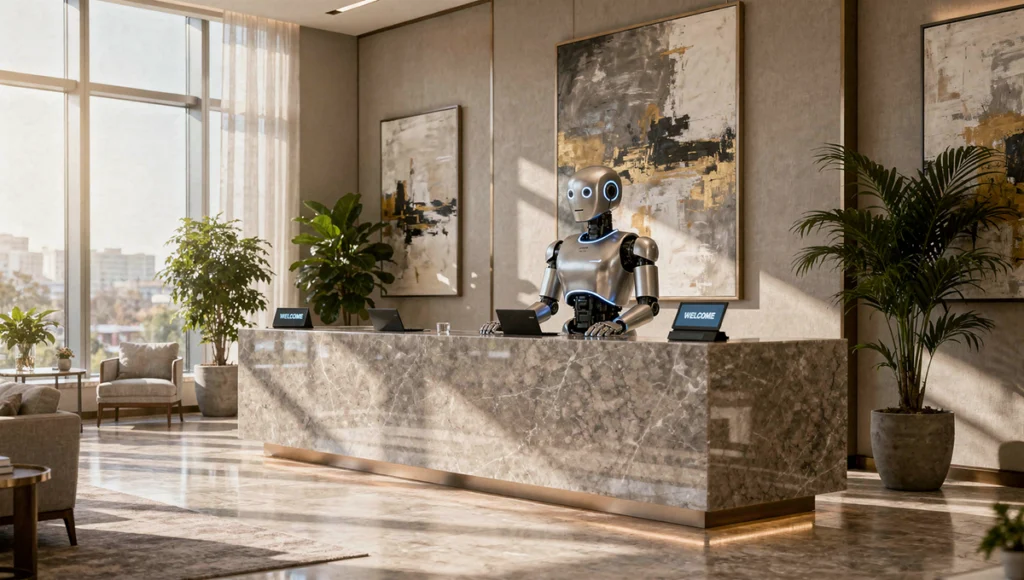
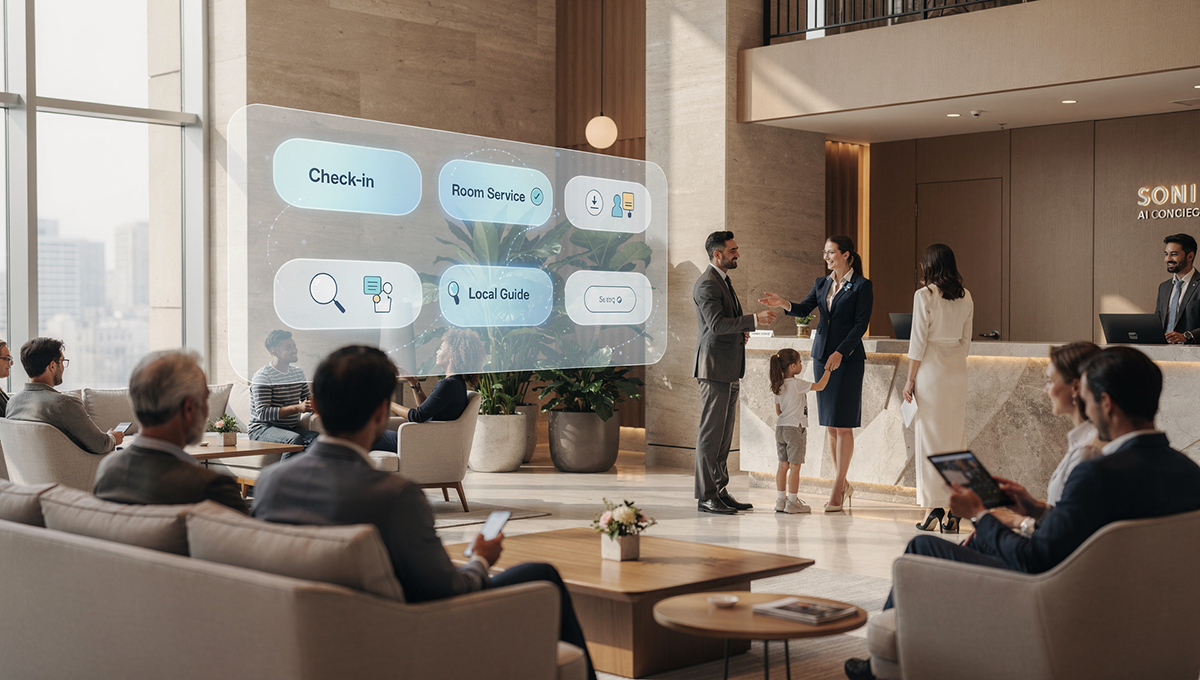
Imagine arriving at a hotel after an exhausting flight and not having to wait in line. That’s the promise already delivered by Otonomus, the world’s first fully AI-powered hotel, which opened in Las Vegas in 2025. Its 303 rooms are booked through “attribute-based booking”: you choose a base rate and customize it by adding features such as proximity to the pool or a quiet area. When you arrive, a robot concierge called “Oto”, fluent in more than 50 languages, welcomes you and remembers your preferences from previous stays.
“The days of one-size-fits-all experiences in hospitality are truly outdated,” says Philippe Ziade, CEO of Otonomus. And the numbers back him up: 63% of travelers prefer digital keys to avoid lines, while a luxury hotel in New York reported a 25% reduction in wait times after introducing voice check-in.
The big chains aren’t falling behind. Hilton uses facial recognition to speed up check-in, and its Digital Key program has been used by more than 135 million guests. Meanwhile, Wyndham rolled out its Wyndham Connect platform across nearly 2,000 hotels in North America, with striking results: AI-enabled properties doubled their growth in revenue per available room and received 25% more positive reviews.
Chatbots that solve problems at 3 a.m.
The real workhorses of hotel AI are chatbots and virtual assistants. They work around the clock, reply in seconds and handle everything from towel requests to restaurant reservations, all without waking up the night receptionist.
“Edward”, the virtual assistant at Radisson Blu Edwardian hotels in London, resolves 75% of inquiries automatically and has served more than 28,000 guests from 99 countries in 59 languages since launch. It became so popular that some guests tried to tip it and nominated it for Employee of the Month. “Edward is a fun, personalized way for our guests to enhance their experience,” explains Michael Mrini, Chief Technology Officer at Edwardian Hotels.
In China, Hilton’s Xiao Xi chatbot has achieved 94% customer satisfaction after answering more than 50,000 inquiries. That’s no coincidence: according to WorldMetrics, chatbots improve response times by up to 90% and can cut customer service costs by 65%.
Generative AI is taking this to the next level. In 2024, IHG Hotels & Resorts, owner of brands such as Holiday Inn and InterContinental, launched an AI-powered travel planner built into its mobile app and developed with Google Cloud. Guests can ask things like “What jazz shows are on near the Holiday Inn Express Manhattan on the weekend of October 12?” and get instant recommendations.
“We’re reimagining how people travel and how they interact with brands,” says Jolie Fleming, Chief Product and Technology Officer at IHG. “This generative AI deployment combines Google’s technical expertise with IHG’s commitment to service.”
Rooms that know you better than you know yourself
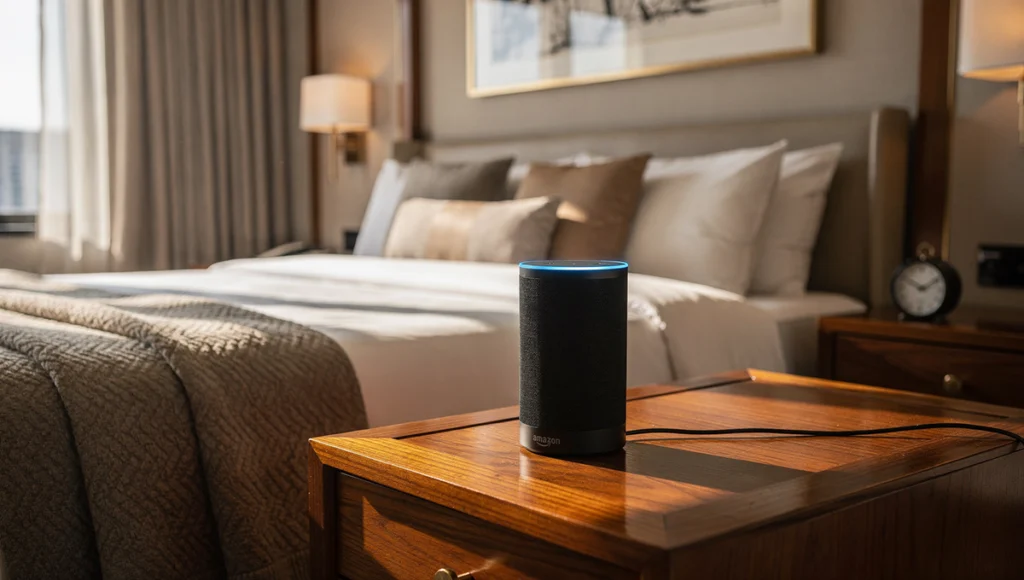
AI-driven personalization is transforming the very idea of a hotel room. At Wynn Las Vegas, more than 2,000 rooms are equipped with Amazon Alexa: just say “Alexa, close the curtains” or “Alexa, order room service” and the magic happens. According to Oracle, 78% of hotel operators expect voice controls to become standard before the end of 2025.
But personalization goes far beyond controlling the lights. AI systems learn from every stay: your preferred temperature, whether you like coffee in the morning, what kind of pillow you prefer. Marriott International invests between $1 billion and $1.2 billion a year in technology, including a “Generative AI Incubator” that is evaluating more than 200 use cases.
“AI is going to transform so many things that we want to experiment with,” acknowledges Drew Pinto, Executive Vice President and Chief Revenue and Technology Officer at Marriott. Its RENAI system, launched at Renaissance hotels, combines recommendations from local staff with ChatGPT to suggest personalized restaurants, bars and experiences.
At Four Seasons, technology serves people, not the other way around. Its Four Seasons Chat system connects guests with real people (not bots) via WhatsApp, WeChat or SMS, with replies in under 60 seconds and automatic translation in more than 100 languages. “We don’t see machines replacing people at Four Seasons in the foreseeable future. Technology can never replace human interaction, but it can help us execute better,” says Christian Clerc, President of Global Operations.
The benefits are measured in millions saved
AI doesn’t just improve the guest experience; it revolutionizes hotels’ operational efficiency. The numbers speak for themselves:
- Hyatt handles 7 million calls a year with AI, saving $4.4 million in operating costs
- Hilton LightStay, its AI-powered energy management system, has generated more than $1 billion in cumulative savings since 2008
- Marriott achieved an 8-10% increase in RevPAR (revenue per available room) thanks to AI-driven dynamic pricing
- Hotels that implement chatbots cut their customer service costs by up to 30%
“AI allows the hotel industry to return to its core mission: delivering exceptional, people-centered experiences. Instead of replacing employees, AI supports them, freeing staff to spend more time with guests,” explains Alix Boulnois, Chief Business, Digital and Technology Officer at Accor.
McKinsey estimates that AI-driven automation could save the hotel industry $160 billion a year once fully implemented, while improving operational efficiency by up to 30%.
The future has already reached the front desk
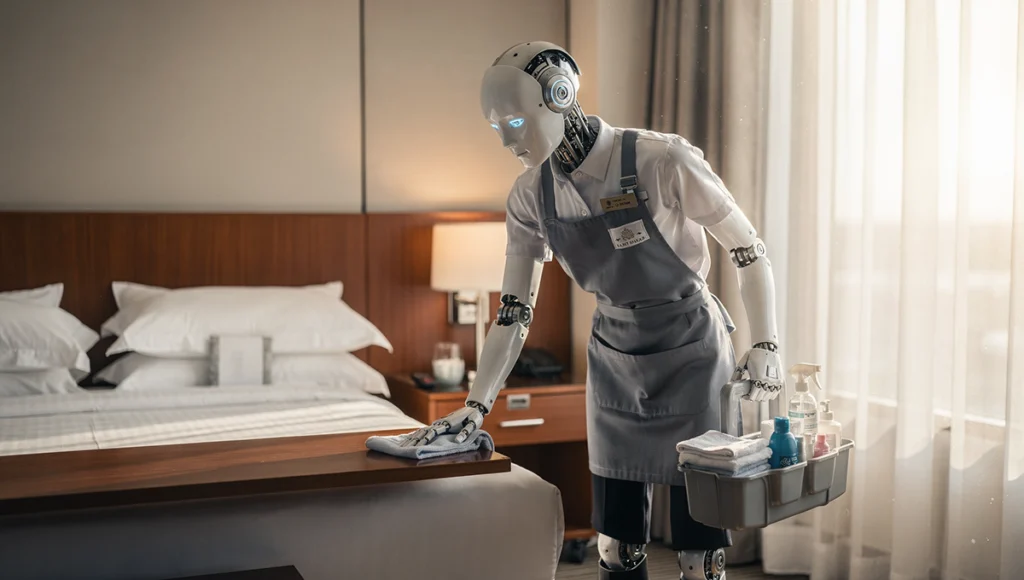
58% of guests believe AI can improve their hotel stay, and 61% are willing to pay more for personalized experiences. Yet only 23% say they currently receive a high level of personalization, a gap that represents a huge opportunity for hotels that embrace these technologies.
“We’ve underestimated the power of AI in hospitality,” admits Guillaume Benezech, Senior Director of Global Brand Management at Ritz-Carlton. “If we don’t move fast enough to keep pace with AI, we risk falling behind.”
The question is no longer whether hotels will adopt AI, but how long it will take them. For travelers, that means less time in line, more personalized recommendations and rooms that seem to know you. For the industry, it’s a transformation on par with the arrival of the internet: those who don’t adapt will become obsolete.
Conclusion
The AI revolution in hospitality isn’t about cold robots replacing human smiles. It’s about freeing staff to do what they do best: connect with people. Chatbots handle the repetitive questions while concierges focus on creating memorable moments. Smart rooms anticipate needs, but the human touch remains irreplaceable when it comes to handling the unexpected.
Perhaps the most telling fact is this: when Radisson launched its virtual assistant Edward, guests didn’t treat it like a machine; they nominated it for Employee of the Month. That anecdote holds the key to the future of hospitality: the technology that works is the technology that feels human.
Sources: NetSuite, MARA AI, Hotel Tech Report, Las Vegas Sun, EHL Hospitality Insights, Hotelbeds, Hospitality Technology, Purple Square AI, Hotel Dive, Wyndham Hotels & Resorts, IHG Hotels & Resorts, World Metrics, Business Wire, Infobip, Four Seasons, Ei3, Alvarez & Marsal, and multiple hotel industry sources.