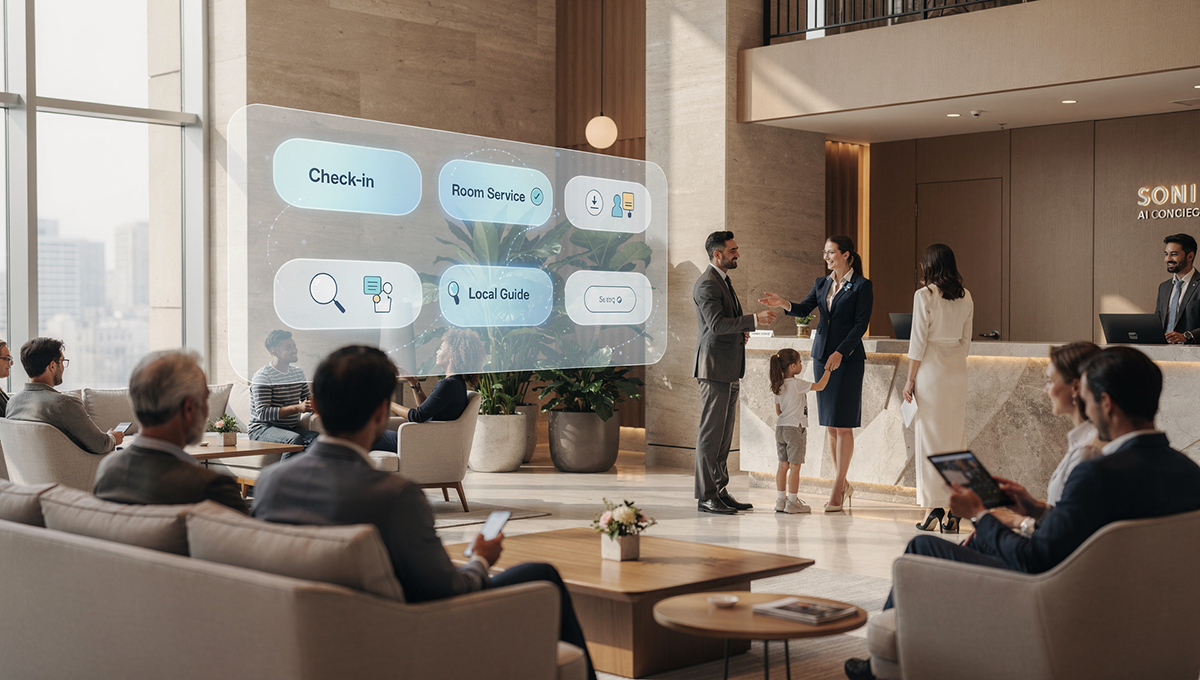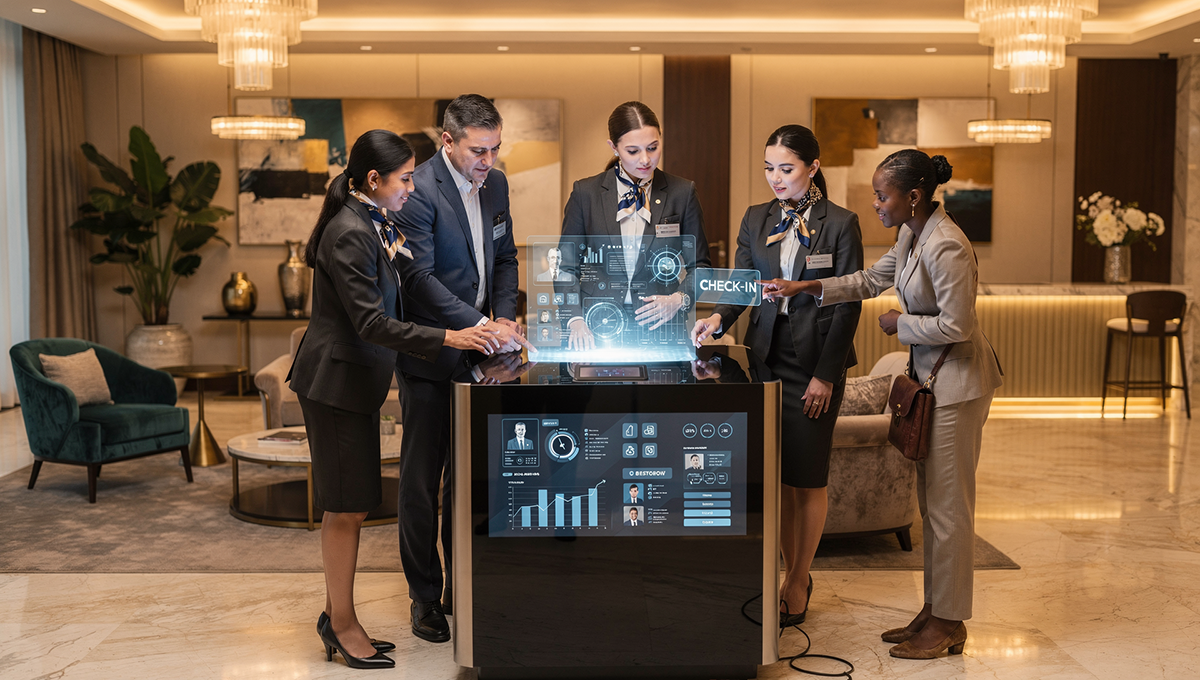
78% of hotel chains already use some form of artificial intelligence, but only 1% consider it central to their business model. That paradox defines the current moment in the hotel industry, where the promise of AI runs into the reality of outdated systems, tight budgets and an uncomfortable question: how do we keep the human warmth while we automate? In 2026, hotels face a fascinating dilemma: adopt technologies that could transform their operations, or fall behind in a race where guests expect more and more personalization and efficiency.
📊 Key Highlights
- The AI-in-hospitality market will grow from $90 million (2023) to more than $8 billion by 2033, a 60% annual growth rate
- 62% of hotel chains lack the technical expertise needed to implement AI solutions effectively
- Only 8% of hotels have a formal AI strategy, while 51% have no clear strategy at all
The AI-in-hospitality market is growing at a dizzying pace. According to Future Market Insights, it will go from $90 million in 2023 to more than $8 billion by 2033, growing 60% a year. But the shiny numbers hide a more complex reality: most hotels are only experimenting, and the obstacles to scaling up are formidable.
62% of hotels lack the expertise needed to implement AI

A lack of technical know-how is by far the most significant barrier. A study by h2c GmbH sponsored by Ireckonu found that 62% of hotel chains identify a lack of expertise as the main obstacle, twice as important as organizational resistance to change (Ireckonu).
The problem goes beyond technical staff; it reaches senior management. As The AI Journal puts it: “AI adoption isn’t just a technology problem, it’s a leadership problem. Many senior managers lack the digital fluency needed to understand, evaluate and implement AI solutions” (The AI Journal).
This skills gap translates into worrying numbers: only 8% of hotel chains have a formal AI strategy, and 51% admit they have no clear strategy for taking advantage of this technology.
When your systems are older than the iPhone
The most frustrating tech challenge isn’t adopting the new, but breaking free from the old. 69% of hospitality professionals say integrating new technology with legacy systems is their biggest challenge, according to Whatfix.
Lauren Hall, CEO of iVvy, put it bluntly in Hospitality Net: “Legacy systems often can’t integrate seamlessly with newer technologies. This limitation can lead to fragmented operations and a disconnected customer experience” (Hospitality Net).
One figure shows the scale of the problem: according to Forrester Research, legacy systems can eat up to 75% of a company’s IT budget on maintenance alone, leaving just 25% for innovation. Hotels end up trapped paying the price for technology decisions made decades ago.
Data fragmentation makes things worse. Only 22% of hotel chains have a centralized data structure capable of supporting AI tools, and 41% face barriers in data quality, accessibility and integration, according to the same h2c GmbH study.
The price of transformation: between $40,000 and $400,000
Implementation costs are a considerable obstacle, especially for independent hotels and smaller chains. According to Appinventiv, developing AI software for hospitality can cost between $40,000 and $400,000, depending on complexity and the integrations required (Appinventiv).
EHL Hospitality Insights warns: “Adopting AI can be costly and complex, often requiring significant upgrades to legacy systems, which creates barriers for smaller operators or those with limited budgets” (EHL Hospitality Insights).
The budget picture isn’t encouraging: only 20% of hospitality operators have a dedicated digital transformation budget, while 63% admit they haven’t invested enough to make real progress.
Still, the return on investment justifies the effort for those who persevere. Mid-market hotels that implement AI automation see payback periods of 8 to 14 months, with 25-35% reductions in operating costs for guest service functions and revenue increases of 12-20%.
Privacy: multimillion-dollar fines and guest trust at stake
Hotel AI is hungry for data: the more guest data it processes, the better its predictions and personalization. But that appetite collides with increasingly strict regulations and guests who are more and more privacy-conscious.
Inside Hospitality lays out the European regulatory landscape: “GDPR fines reach €20 million or 4% of global turnover; the AI Act raises that to €35 million or 7%. Add reputational damage, civil lawsuits and the possible suspension of your AI systems” (Inside Hospitality).
The case of Marriott, fined $125 million under the GDPR, serves as a warning. As Secure Privacy notes: “If Marriott is struggling with the GDPR, many other hotels are probably falling short of Europe’s new data privacy regulation” (Secure Privacy).
The concern is mutual: 67% of travelers say they’re worried about how their data is used in hotel AI systems, according to a Cornell University study.
How the big chains are innovating: from robot concierges to assistants that assign 1.2 million rooms
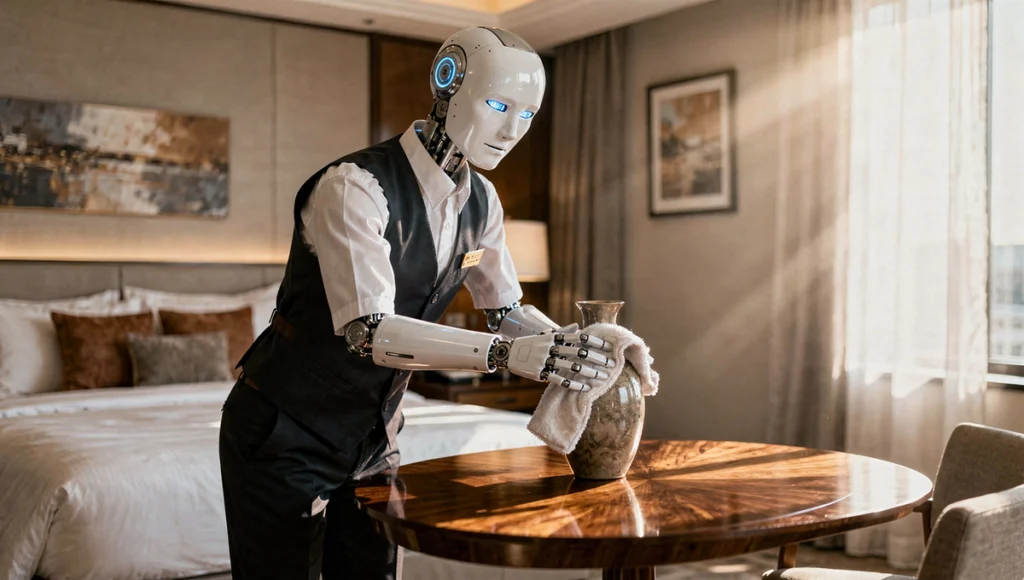
Despite the challenges, the leading chains are pulling off impressive implementations.
Marriott International invests $1 billion to $1.2 billion a year in technology and has developed an AI tool that can assign 1.2 million rooms in a fraction of a second, saving front desk staff hours of manual work. Naveen Manga, Marriott’s Global CTO, presented this innovation at the 2025 Skift Data and AI Summit (Skift).
Hilton stands out with LightStay, its AI-powered energy management system developed with ei3 Corporation. The results, verified by external auditors, are remarkable: more than $1 billion in cumulative savings since 2008, along with a 30% reduction in carbon emissions and a 20% reduction in energy and water use (ei3). Hilton also currently has 41 AI experiments underway, as Skift reported in October 2025 (Skift).
IHG Hotels & Resorts partnered with Google Cloud to build a generative AI Travel Planner that handles natural-language requests like “Give me four late-dinner options near the InterContinental London Park Lane” (IHG). It also rolled out Winnow Vision, an AI technology for reducing food waste, achieving a reduction of more than 50% in just six months at the InterContinental Fujairah Resort.
Hyatt adopted the Snowflake AI Data Cloud across its 1,300 properties worldwide, democratizing access to data and significantly reducing the time spent on manual data management (Diginomica).
The impossible balance: efficient machines, empathetic humans
The deepest debate in the industry isn’t technological but philosophical: how do you preserve the essence of hospitality while automating processes?
Professor Ian Millar of EHL’s Institute of Business Creativity offers a balanced perspective: “AI should complement human skills, not replace them. It can increase efficiency, but without reliable integration, training and a people-centered approach, its purpose remains limited” (EHL Hospitality Insights).
Henri Roelings, founder of Hospitality Net, sums up the challenge for 2026: “The winners in 2026 won’t be those who choose technology or humanity, direct or distribution, efficiency or experience. They’ll be the ones who figure out how to deliver both without compromise. That’s harder than picking a side, but it’s what the market increasingly demands” (Hospitality Net).
The statistics reflect this dilemma: 56% of respondents believe AI accuracy needs “a lot of improvement” before it can be fully trusted, and 63% believe human interpretation is still necessary when using AI tools, according to Hospitality Technology.
2026 and beyond: the race not to fall behind
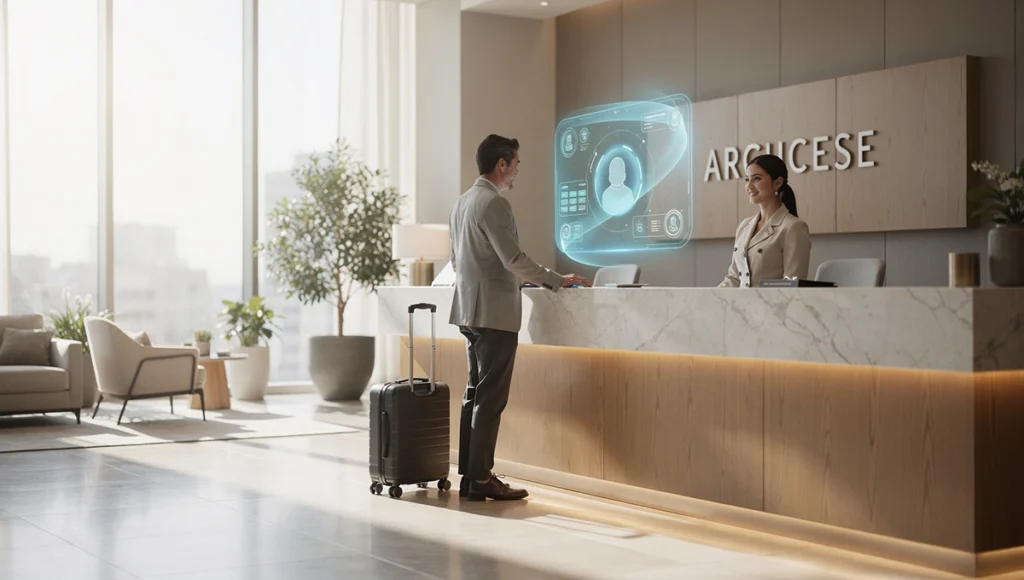
McKinsey predicts that 95% of hospitality businesses will need to significantly transform their operating models by 2026 to stay competitive. AI can improve operational efficiency by up to 30%, but reaching that potential requires overcoming today’s obstacles.
The next horizon is already in sight: agentic AI, systems that act and adapt in real time without human intervention. According to McKinsey and Skift, 90% of travel executives use generative AI in some capacity, but only 2% say the same about agentic AI (McKinsey). That gap is both a challenge and an opportunity.
Niki Van den Broeck of Lighthouse anticipates fundamental changes: “The use of AI for travel planning doubled in the past year. We expect that growth to accelerate rapidly in 2026, with generative AI moving beyond itinerary creation to become a core tool for search, comparison and booking” (Lighthouse Intelligence).
Conclusion: the time to act is now
The AI challenges hotels face in 2026 are formidable but not insurmountable. The lack of expertise, outdated systems, implementation costs, privacy concerns and integration challenges form a wall that many hotels find intimidating.
However, the chains investing strategically, from Hilton with its billion dollars in energy savings to Marriott with its ambitious AI program, show that the path is viable. The key isn’t choosing between technology and humanity, but using the first to empower the second: automating the repetitive so staff can focus on building genuine connections with guests.
The hotel industry is at a crossroads where inaction comes at a growing cost. As the numbers show, the AI-in-hospitality market is growing exponentially, and guests, especially younger ones, expect more and more personalization and immediacy. Hotels that manage to balance technological innovation with human warmth won’t just survive: they’ll define the future of hospitality.