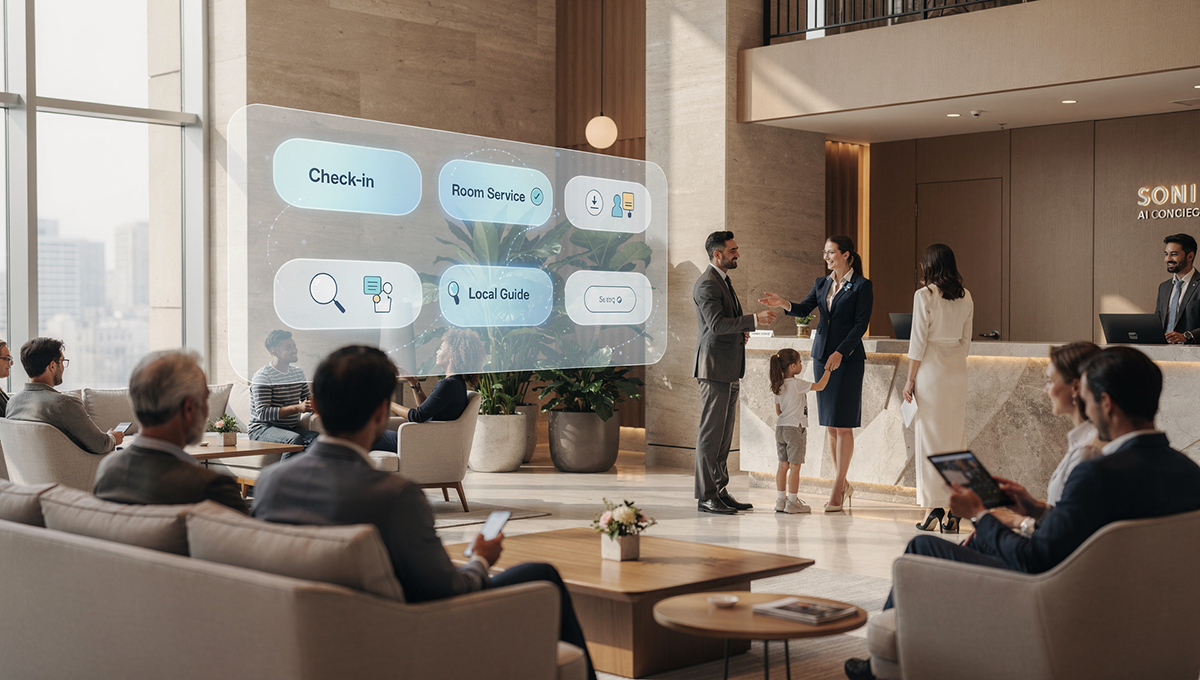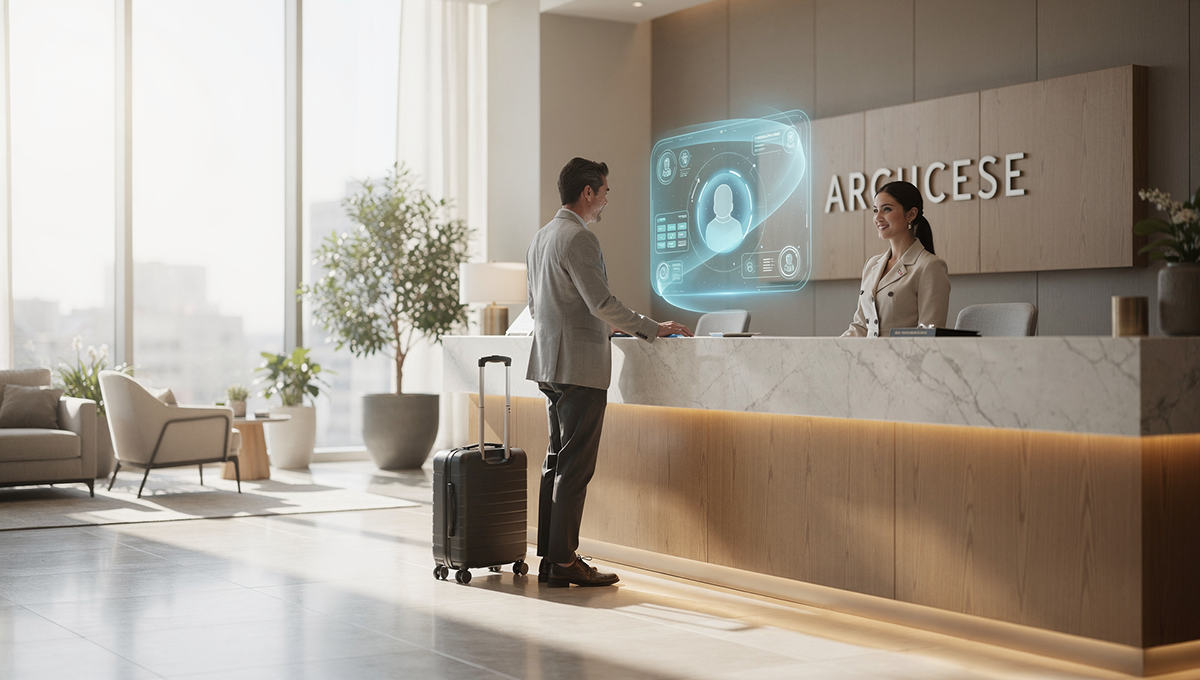
The year 2026 is a turning point for AI adoption in the hotel industry. Hotels that treat this year as just a planning exercise will lose competitive ground, while those that implement AI strategies now will capture significant advantages in revenue, operational efficiency and guest satisfaction. According to the Mews 2026 Hospitality Industry Outlook, by 2035 most hotel bookings will happen through a single conversation with AI, and at least half of administrative tasks will be automated. The AI-in-hospitality market will grow from $150 million in 2024 to $1.46 billion in 2029, a compound annual growth rate of 57.8%.
Wouter Geerts, Director of Market Research at Mews, warns: “Hospitality is at a tipping point. Hotels that treat 2026 as a planning year will lose ground.” That urgency shows in the data: 78% of hotel chains already use AI, and 89% plan to expand their applications in the next 12-24 months, according to the H2c study from October 2025.
Today’s Landscape Reveals Critical Opportunities and Challenges
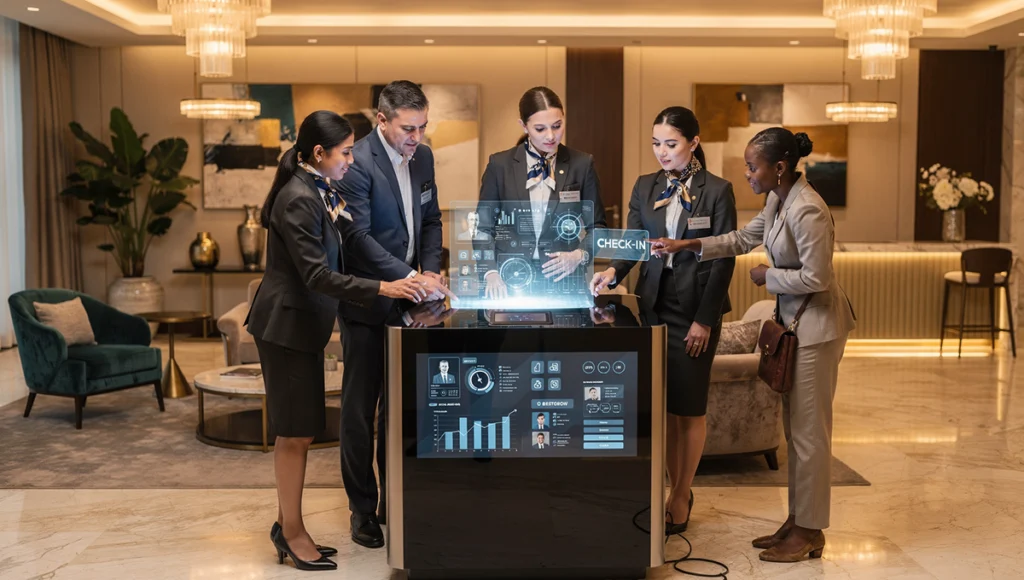
AI adoption in the hotel industry presents a telling paradox. Although most chains use some form of artificial intelligence, only 7% have a comprehensive enterprise-wide AI strategy. Hoteliers give AI a confidence score of 6.6 out of 10, but their actual reliance on it averages just 4.7, revealing a significant gap between perception and action.
Michaela Papenhoff, Managing Director of H2c, explains: “AI adoption in hospitality is accelerating, but most hotel chains are still experimenting. Closing the gap between confidence and reliance will require more investment in staff skills, better integration, clear ROI measurement and a focus on use cases that deliver tangible value.”
For those who implement it well, the results are compelling. The TakeUp AI Hospitality Revolution 2025 study, based on 200 independent properties, found that 74.5% see positive results, with 25.5% experiencing revenue increases of 6-10% and 35% reporting increases of 11-20%. Bobby Marhamat, CEO of TakeUp, notes: “Independent owners aren’t just testing AI; they’re using it to win. The fact that 74% say AI has met or exceeded expectations debunks the myth that small properties can’t succeed with AI.”
Chatbots and Virtual Assistants Are Transforming Guest Service
The first area where hotels should prioritize AI investment is guest communication. Chatbots are currently the most widespread application, with 42% adoption among hotel chains, and for good reason: they can handle 70% of inquiries without human intervention, with response times 8-10 times faster than traditional methods.
Marriott International leads this transformation with chatbots on Facebook Messenger and Slack that have achieved a 65% reduction in call center volume, generating estimated savings of $2.3 million a year across its North American properties. Complaint resolution time fell by 50%, and more than 60% of users come back to the virtual assistant.
The chain is also piloting RENAI at its Renaissance hotels, a virtual concierge that combines ChatGPT with insights from local human experts. Eddie Schneider, Global Brand Director, explains: “RENAI helps filter the flood of information available to travelers and personalize the guest experience.” Guests access it via a QR code to receive local recommendations by text or WhatsApp.
Hilton introduced Connie, a robot concierge powered by IBM Watson, and achieved a 94% satisfaction rate with its Xiao Xi chatbot in China, which has handled more than 50,000 inquiries and cut resolution time by 25%. The Cosmopolitan of Las Vegas deployed “Rose,” a chatbot with a witty personality that handles restaurant reservations, towel requests and personalized service.
For boutique hotels, the results are just as promising. The Brown Hotel in Louisville, with just 35 rooms, has its chatbot handle 65% of pre-stay inquiries while keeping the hotel’s unique voice. The Holiday Inn Express Orlando SeaWorld generates $1,700 a month in additional sales through its chatbot.
Leading platforms include Canary Technologies (answers 80% of inquiries in more than 100 languages), Quicktext Velma (multilingual support that drives direct bookings) and HiJiffy (end-to-end guest communication). The practical recommendation is to start with a chatbot that integrates with your existing property management system (PMS), prioritizing high-volume use cases such as FAQs, service requests and reservations.
AI-Driven Personalization Elevates the Guest Experience
61% of consumers are willing to spend more for personalized experiences, according to Medallia 2024, yet only 23% of guests say they receive highly personalized service. That gap is a massive opportunity for competitive differentiation.
Otonomus Hotel in Las Vegas, scheduled to open in 2025 as the first fully AI-powered hotel in the United States, sets the new standard. It offers attribute-based booking, where guests select a base room and customize it with specific features (a quiet location, proximity to the pool); AI that adjusts the room’s ambiance (lighting, temperature) to their preferences; digital twin avatars; and sustainability discounts for energy-conscious guests.
Virgin Hotels shows practical personalization with its “Lucy” app, connected to smart room systems. It controls lights, thermostat, streaming, room service and TV, and integrates with guest profiles to remember preferences from previous visits and apply them automatically at check-in.
In the luxury segment, The Setai Miami Beach introduced “The Oracle,” which controls room features, provides local recommendations and learns guest preferences over time. Waldorf Astoria Maldives uses “Living AI” to personalize experiences with advanced AI.
The data supports the investment: properties with multilingual voice assistants achieve 27% higher guest satisfaction among international travelers, according to Marriott data. One hotel chain that implemented an AI-driven booking system saw a 40% increase in repeat bookings through personalized recommendations and loyalty incentives.
The recommendation for 2026 is to implement systems that automatically capture and act on guest preferences, starting with simple integrations such as remembering preferred room temperature, pillow type or minibar preferences, and scaling toward predictive personalization based on stay history.
Voice Assistants and Smart Rooms Define the Near Future
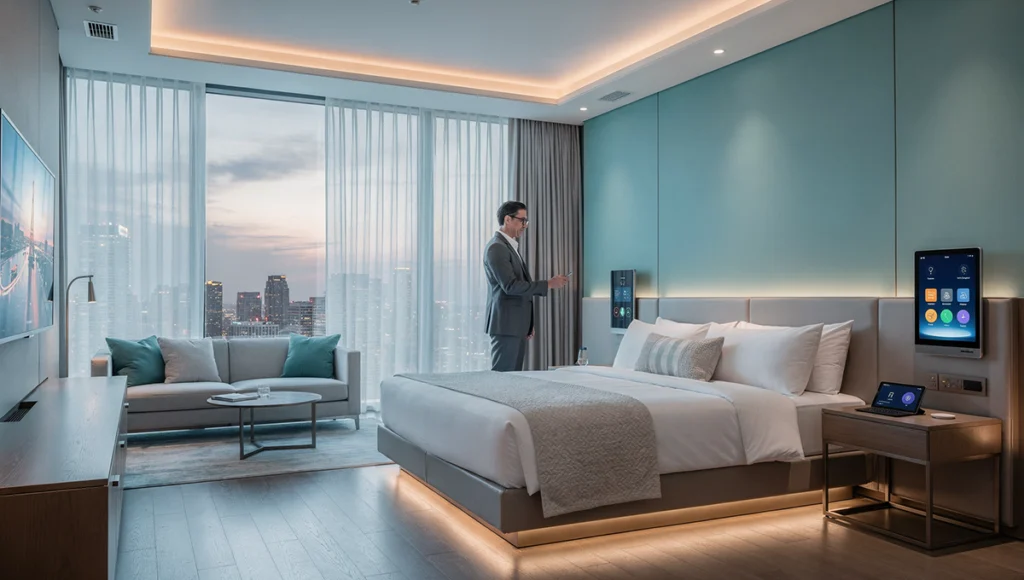
73% of travelers prefer to stay at hotels that offer self-service technology, and 40% of hotel leaders consider voice-activated devices among the most promising technologies for the coming years. Amazon Alexa Smart Properties for Hospitality leads this space, with deployments at Reverb Atlanta, Circa Resort & Casino Las Vegas, Fairmont Le Manoir Richelieu, NH Collection Spain, BWH Group Italy, Sofitel France, The Wynn Las Vegas and select Walt Disney World properties.
Circa Resort & Casino in Las Vegas, with 512 rooms, achieved 88% guest satisfaction with in-room Echo Show 8 devices. Co-founder Greg Stevens says: “You need to embrace technology or you’ll get left behind.” Guests request towels, order room service and control the room’s ambiance with voice commands.
Wynn Las Vegas reports transformative results: more than two-thirds of guests prefer rooms with Alexa, 84% are satisfied or very satisfied with the digital service, room service revenue rose 12%, response speed improved 30% and overall guest satisfaction went up 20%. AI found that demand for burgers peaks between 10 and 11 p.m., so the late-night menu was expanded accordingly.
Smart room technology capabilities include voice control of lighting, temperature, blinds and TV, room service orders, local attraction recommendations, Wi-Fi password retrieval, workout instructions and integration with property management systems. The recommended investment for 2026 is to pilot voice assistants in a share of rooms, measuring the impact on guest satisfaction and service usage before scaling up.
AI Revenue Management Maximizes Revenue per Available Room
85% of hotels plan to increase investment in AI-driven pricing technology over the next two years, up from 78% in 2024. AI-based forecasting models are 25% more accurate than traditional methods, and the global market for hotel revenue management software will reach $2.8 billion by 2027.
Marriott International processes more than 80 distinct data points in its Revenue Strategy Platform (up from 40 variables in 2022), achieving a 22% improvement in RevPAR across its properties. Its “Personalized Experience Platform” delivered a 50% increase in ancillary revenue and a 25% improvement in guest satisfaction.
Hilton Hotels uses AI-driven segmentation and dynamic pricing that increased revenue by 5-8%, while its WorkSpaces program achieved a 600% increase in extended-stay bookings compared with pre-pandemic levels.
IHG implemented “Smart Pricing,” a value-based pricing approach that increased customer lifetime value by 35%. Hyatt Hotels developed a differential depreciation model that resulted in a 32% increase in repeat bookings from high-value customers. Four Seasons Resort Whistler applied AI-driven weather impact analysis to achieve a 28% increase in off-peak revenue.
AccorHotels showed strategic innovation with “reverse surge pricing” during the 2025 Paris Exposition, reaching 99% occupancy with 35% higher RevPAR than competitors.
Leading platforms include Duetto (ranked number 1 by Hotel Tech Report in 2025, serving more than 7,200 properties), IDeaS (enterprise-scale revenue management), Atomize (increases RevPAR by up to 25% in 3-6 months and saves 20-30 hours a month), RoomPriceGenie (ideal for small and mid-sized hotels) and Lighthouse Pricing Manager (19%+ RevPAR increase).
Darrell Stark, VP of Sales at Noble House Hotels & Resorts, offers a balanced perspective: “AI enhances personalization and speeds up decision-making, redefining revenue management. Its potential is undeniable, but its role will be evolutionary rather than revolutionary.”
AI-Driven Energy Efficiency Delivers Massive Savings
AI systems can cut hotel energy consumption by up to 30%, a critical figure given that 60% of a hotel’s carbon emissions come from HVAC and lighting systems. 61% of global travelers prefer to stay at eco-friendly hotels, making sustainability a competitive advantage.
Hilton Hotels leads with its LightStay platform, which has generated more than $1 billion in cumulative savings since 2008, verified by KEMA and DEKRA. The system achieved a 30% reduction in carbon emissions and waste production and a 20% reduction in water and energy use. It’s mandatory for all of Hilton’s 5,400+ properties in 106 countries and uses AI mathematical models that compare real-time data against historical models.
Proximity Hotel in Greensboro, North Carolina, earned LEED Platinum certification with AI-managed energy systems, achieving 39% lower energy use than other hotels.
Scandic Hotels Group adjusts rates based on environmental impact metrics, achieving a 30% increase in bookings of eco-friendly rooms. At a hotel in Poznań, Poland, Exergio demonstrated a 20% reduction in energy waste in 9 months, translating into roughly €80,000 (~$87,431) in savings.
Donatas Karčiauskas, CEO of Exergio, predicts: “As AI continues to advance, we expect energy management systems to become increasingly sophisticated. AI will become a core tool for hotels looking to balance sustainability, cost efficiency and a superior guest experience.”
Predictive Maintenance Eliminates Costly Disruptions
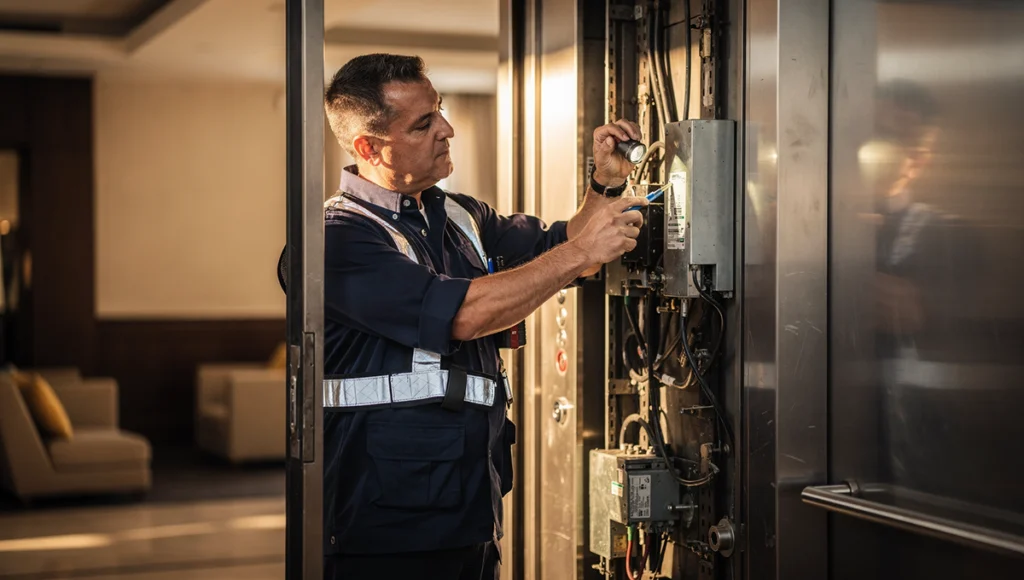
AI-driven predictive maintenance cuts maintenance costs by 25-30%, reduces unplanned outages by 70-75% and extends equipment life by 20-40%. Considering that unplanned downtime costs businesses an average of $260,000 per hour, the investment pays for itself quickly.
Hyatt Hotels implemented a predictive maintenance system that monitors HVAC units, elevators and critical systems with sensors that predict potential failures before they happen. The benefits include less unplanned downtime, lower repair costs and higher guest satisfaction.
One resort (a case documented by HFTP) used AI predictive maintenance to achieve a 40% reduction in equipment downtime and a 25% decrease in maintenance costs, with a 15% improvement in satisfaction scores thanks to fewer disruptions.
The technology components include IoT sensors for HVAC, elevators, kitchen appliances and plumbing; AWS Bedrock AI models for predictive analysis; machine learning algorithms that analyze patterns in sensor data; and real-time monitoring with automated alerts.
AI Workforce Management Boosts Productivity and Cuts Costs
Hotels that use AI for demand forecasting see an average 5% increase in revenue. AI scheduling achieves reductions of more than 50% in room turnaround times, task completion rates above 99%, and staff turnover drops by 15-20% with AI feedback tools.
Marriott International analyzes occupancy rates and guest preferences to optimize housekeeping assignments, improving efficiency and service standards. Hilton Hotels uses AI-driven analytics to anticipate guest flow and predict staffing needs, dynamically adjusting labor plans and minimizing costs in low season. Accor Hotels streamlines housekeeping schedules and task assignments in real time, improving response and room turnaround times.
A pilot of the AMIS Framework at a hotel in Thailand showed a reduction of more than 50% in average room turnaround times and a task completion rate above 99%, reducing staff working hours with balanced workloads.
Leading platforms include Unifocus (AI scheduling and real-time labor tracking), Workforce.com (machine learning demand forecasting), Actabl’s Hotel Effectiveness (ML for optimal staffing) and Flexkeeping (AI-enabled, voice-driven task management).
Security and Fraud Prevention Protect Revenue
Online fraud is nearly seven times more prevalent than in-person credit card fraud, according to Mastercard, and chargebacks are growing 20% a year. AI tackles multiple types of fraud: fake reservations with stolen cards, card-not-present fraud, fraudulent chargebacks, false identity verification and screening of problem guests.
Autohost offers an AI-powered guest screening platform that reduces fraud by 90% through contactless verification, ID checks, biometric checks and criminal background checks. Sertifi + Kount (Equifax) provides machine learning fraud prevention for credit card authorization, using supervised and unsupervised ML models, risk scoring (A-F scale) and real-time transaction analysis.
AI security capabilities include anomaly detection in transaction patterns, phishing attempt blocking, login behavior analysis, computer vision for facility monitoring and identity verification with biometric matching.
The Return on Investment Justifies Faster Adoption
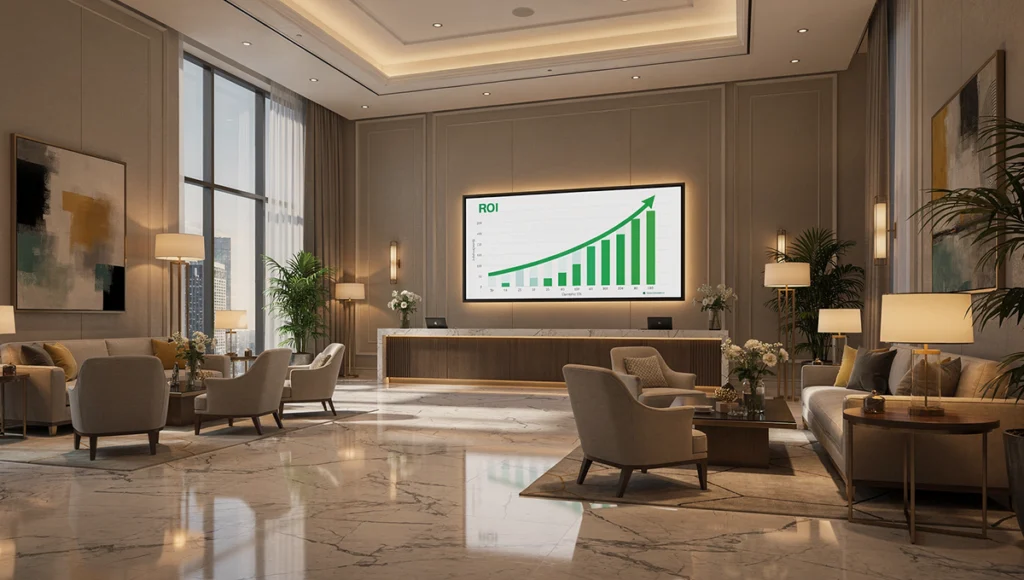
The ROI data is convincing. The average revenue increase from AI is 22%, according to Smith Travel Research 2025, with industry-average RevPAR improvements of 15-22%. McKinsey reports that hotels leveraging AI achieve a 17% increase in revenue and a 10% rise in occupancy. Customer lifetime value typically increases by 25-35%, and booking conversion rates improve by 20-40%.
In operational savings, AI automation cuts administrative costs by 20-40%, AI scheduling lowers labor costs by 12%, smart energy management saves 30%, predictive maintenance cuts costs by 25-30% and equipment downtime falls by 40%.
ROI timelines are favorable: most properties see positive ROI within 90 days for AI messaging tools, with 300-500% ROI within 12 months across multiple tools. Mid-range hotels report payback periods of 8-14 months.
Riverside Hotel in Seattle implemented an AI hotel management system in early 2024, achieving a 22% increase in RevPAR in 8 months, a 35% reduction in complaint resolution time, an 18% improvement in staff productivity and full payback in 11 months. Boutique Garden Hotel in Portland, with 32 rooms, achieved a 28% increase in direct bookings, a 15% improvement in guest satisfaction and a 40% reduction in administrative time.
A Practical Implementation Roadmap for 2026
The Mews report proposes a four-step framework to get ready. First, assess your tech stack and data: map your core systems (PMS, CRM, messaging, housekeeping, POS, payments) and identify silos, data gaps and integration opportunities. Second, get your content AI-ready: make sure your content is clean, structured and consistent for AI-driven search and booking systems. Third, run a supervised AI pilot: start with specific, measurable use cases to refine workflows and measure impact. Fourth, build governance and team buy-in: set up cross-functional teams and train staff on new AI-enhanced workflows.
The main barriers to overcome include a lack of expertise (62%), an unclear strategy (51%), integration difficulties (45%), high costs (39%), organizational resistance to change (31%) and data security concerns (30%). The key is to start small, prove value and scale systematically.
Klaus Kohlmayr, Chief Evangelist at IDeaS, sums up the vision for 2026: “Hospitality is at a pivotal moment where technology, AI and unified strategies can unlock new ways of operating. This isn’t about replacing people; it’s about empowering them to simplify complexity, innovate faster and deliver experiences that drive both profitability and sustainability.”
Conclusion
Integrating AI into hotels by 2026 isn’t optional; it’s a competitive imperative. The data shows that 78% of chains already use AI, with tangible results: revenue increases of 15-22%, operating cost reductions of 20-40% and guest satisfaction improvements of 15-20%. The gap between leaders and laggards will widen dramatically.
Investment priorities should be: chatbots for guest communication (42% adoption, 70% of inquiries automated), AI revenue management (22% RevPAR improvement), smart energy management (30% savings) and predictive maintenance (25-30% cost reduction). Small and mid-sized hotels can compete effectively through SaaS platforms such as RoomPriceGenie, Canary Technologies and Quicktext, which democratize access to capabilities once reserved for big chains.
The time to act is now. As Mews warns, by 2035 most bookings will happen through conversations with AI, and hotels that wait until then to adapt will find that the transformation needed to start in 2026.
References
- Mews. (2024). AI tipping point: Mews warns 2026 is make-or-break year for hotel transformation. PR Newswire.
- PhocusWire. (2025). Hotel chains struggle with AI strategy, independents see fast ROI.
- Hotel Tech Report. (2024). AI in Hospitality Statistics: 48 Statistics That Prove the Industry Is in Hypergrowth.
- AIMultiple. (2024). Hospitality Chatbots: Top Use Cases and Case Studies.
- Hotel Dive. (2024). Marriott’s Renaissance Hotels debuts AI-powered ‘virtual concierge’.
- Amazon Developers. (2024). Circa Resort & Casino uses Alexa to deliver personalized guest experiences.
- Revenue Hub. (2024). The AI Revolution in Hotel Pricing: Beyond Dynamic Rates.
- Duetto. (2024). World’s best revenue management software for hotels.
- ei3. (2024). Hilton’s AI-Driven Energy Management Achieves $1 Billion Savings.
- TTG Asia. (2024). AI the key to reducing energy waste at hotels.
- HFTP. (2024). The AI Revolution in Hospitality: How Artificial Intelligence is Reshaping Hotel Finances.
- ScienceDirect. (2025). Leveraging AI-driven dynamic scheduling systems for complex resource optimization.
- Unifocus. (2024). Make the Smarter Choice for Hotel Workforce Management.
- Autohost. (2024). AI-Powered Screening and Background Checks for Hospitality.
- Hospitality Net. (2024). AI-Driven Personalization: How Hospitality Brands Achieve 40% Increases in Repeat Bookings.
- TechVerdi. (2025). AI Hotel Management Systems: Complete Implementation Guide 2025.
- EHL Hospitality Insights. (2024). AI in the Hospitality Industry: Benefits, Challenges & What’s Next.
- SiteMinder. (2024). AI in the hospitality industry: Artificial intelligence for hotels.